ForgeWheel blog · May 23, 2026
AI Is Here. Pretending Otherwise Is Not a Strategy.
Artificial intelligence is not coming someday. It is already here, standing in the room, touching everything, and probably reorganizing your workflow while you complain about it.
Some people still talk about AI like it is a fad, a toy, or a weird tech experiment that will politely go away if enough people sneer at it. That is adorable. Also wrong.
AI is becoming part of writing, research, coding, marketing, design, customer service, education, medicine, business operations, and probably seventeen other things before lunch. It is not limited to giant corporations anymore, either. There are now AI models you can run on your own PC, locally, without sending every thought into the glowing corporate cloud. That means this technology is spreading downward, outward, and everywhere in between.
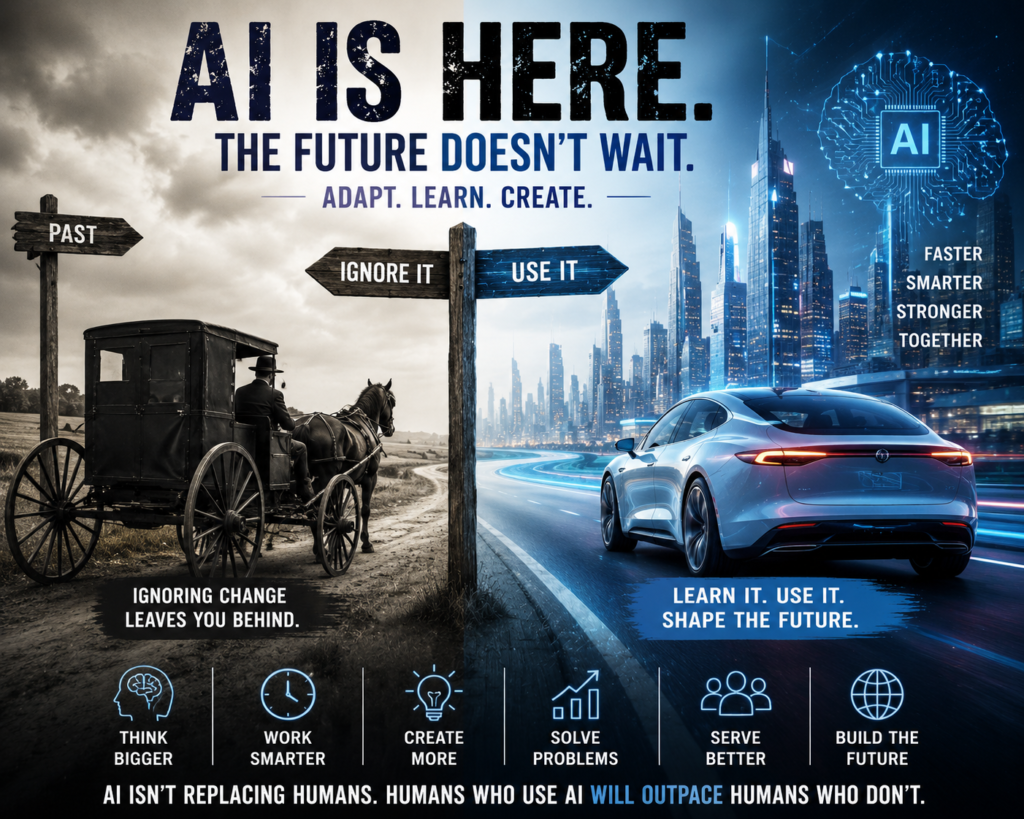
This is not the first time people have faced a major technological shift. The horse and buggy did not lose because horses were suddenly useless. They lost because cars changed the scale, speed, and economics of transportation. The people who adapted gained an advantage. The people who refused often found themselves standing in the road, holding reins, wondering why business had moved on without asking permission.
AI will be the same kind of disruption.
That does not mean everyone should blindly worship it like some shiny silicon idol. AI has problems. It can be wrong. It can be biased. It can produce lazy, soulless garbage when used badly, which humanity was already producing just fine on its own, but now faster. It requires judgment, ethics, editing, and human direction. Used carelessly, it can make dumb people louder. Used well, it can help capable people move faster, think broader, and build things they could not have built alone.
The real divide will not be between people and machines. It will be between people who learn to use powerful tools and people who insist the tools do not matter.
You do not have to love AI. You do not have to trust it blindly. You do not have to replace your brain with a chatbot and call it innovation, which would be a very modern way to make yourself obsolete.
But ignoring AI is no longer a serious plan.
Learn it. Test it. Challenge it. Use it where it helps. Reject it where it weakens the work. Keep your standards. Keep your judgment. Keep your humanity.
Because AI is not going anywhere.
And history is not especially kind to people who stand in front of the future yelling, “I prefer the buggy.”