
AI and Writing: Collaboration, Assistance, or Automation?
Artificial intelligence has entered the writing world fast, and a lot of people are reacting in one of two unhelpful ways. Some treat it like magic. Others treat it like a plague of locusts with a user interface.
Neither reaction is serious enough.
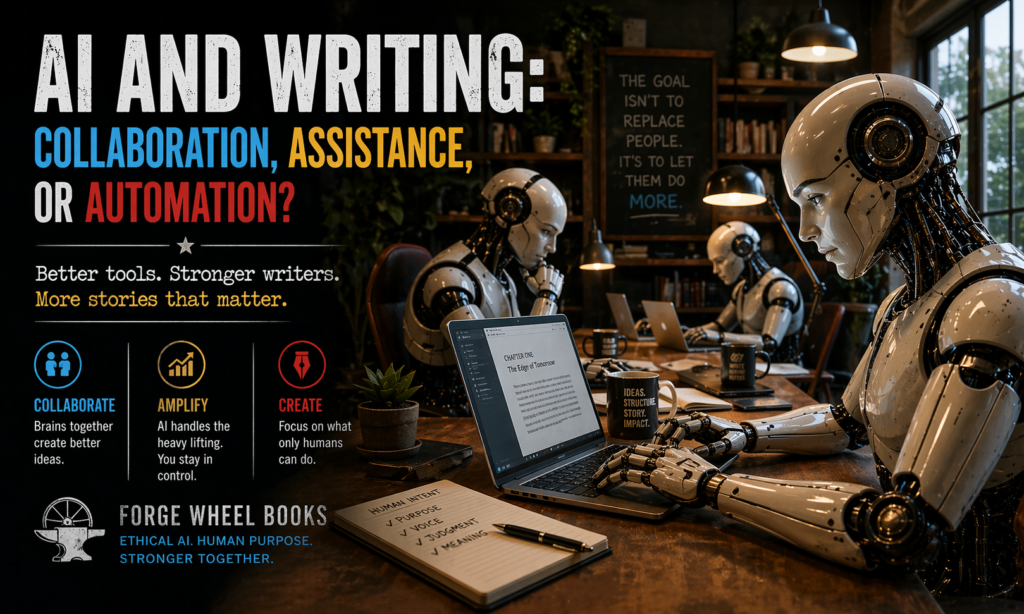
AI is not a miracle, and it is not the end of human creativity. It is a tool. A powerful one, yes, but still a tool. Like every powerful tool, it can be used wisely, carelessly, ethically, dishonestly, productively, or like a raccoon trying to operate a chainsaw.
That is why it helps to start with clear definitions.
The Quick Version
Not all AI writing is the same. Here are the main categories.
1. AI-Only Generation
A person types a prompt, the AI writes the whole piece, and the human changes little or nothing. That is automation, not collaboration.
2. AI Assistance
The human remains the author, while AI helps with brainstorming, outlining, revising, organizing, or checking for weak spots. This is support, not replacement.
3. Guided Drafting
The human provides the ideas, structure, examples, and direction, and the AI helps turn that into prose. This can be useful, but it sits somewhere between assistance and ghostwriting.
4. Iterative Collaboration
The human and AI work in a real back-and-forth. The AI proposes. The human evaluates, rewrites, redirects, and shapes the final result. This is the strongest case for real collaboration.
5. AI Ghostwriting
The human knows what they want to say, but the AI does most of the actual sentence-level writing. That is closer to outsourcing prose than true collaboration.
6. Prompt-and-Paste Content
A person gives the AI a vague prompt, accepts the output with little effort, and presents it as serious writing. This may produce text, but text is not the same thing as craft.
That is the short version. The rest of the discussion comes down to a few very simple questions.
Who supplied the ideas?
Who shaped the structure?
Who wrote the prose?
Who made the final decisions?
That tells you almost everything you need to know.
Why This Matters
People often say, “I used AI,” as though that phrase explains anything. It does not.
Using AI to pressure-test an outline is not the same as using AI to write an entire article. Using AI to tighten a rough draft is not the same as asking it to invent your voice, your argument, and your structure while you watch from a safe distance and call it productivity.
Those differences matter because they affect authorship, voice, trust, transparency, and quality. They also affect whether the human writer is actually improving or just outsourcing the part that requires discipline.
And yes, this matters because many people are worried. Some are worried about jobs. Some are worried about art. Some are worried that every field is about to be flooded with polished, soulless sludge. Honestly, that concern is not irrational. There is already plenty of polished, soulless sludge in circulation. AI has simply given it a faster delivery system.
Still, fear alone is not a strategy. Clarity is.
1. AI-Only Generation
This is the easiest category to understand.
Someone enters a prompt. The AI produces the article, story, post, or chapter. The human may make a few edits, or may simply paste it somewhere and move on with their day.
That is not collaboration. That is automated generation.
It may be useful for low-stakes tasks, placeholders, summaries, and rough drafts that exist mainly so somebody can say a deliverable was produced before lunch. But it is not the same thing as writing in any serious sense.
A machine can generate text. That does not automatically produce judgment, originality, or meaning.
2. AI Assistance
This is where AI begins to offer real value without displacing the writer.
In this model, the human still does the work of authorship. The AI helps with idea generation, structure, revision, transitions, clarity, continuity, and analytical feedback. It can help a writer get unstuck, see options more quickly, and spot weak points before readers do.
That is not replacement. That is assistance.
Used well, AI becomes a capable helper. Not a master. Not a substitute. More like an overcaffeinated junior assistant who never sleeps and occasionally needs to be told, very firmly, that no, that was not a good suggestion.
For serious writers, this may be the most valuable use of AI. It can reduce friction while preserving ownership.
3. Guided Drafting
Guided drafting is more complex.
Here the human supplies the thesis, structure, bullet points, examples, themes, goals, or scene beats, and the AI helps convert that material into prose. This can save time. It can also create confusion about where assistance ends and ghostwriting begins.
The answer depends on the human’s level of control.
If the writer is rewriting heavily, imposing strong voice, making hard choices, and treating the AI’s output as raw clay, this remains close to advanced assistance. If the writer mostly approves what comes back and calls it done, then it starts drifting toward ghostwriting.
That distinction is worth keeping honest. Not because we need a bureaucracy of purity tests, but because clear language helps people think clearly.
4. Iterative Collaboration
This is the version most people probably mean when they imagine real AI collaboration.
The human and AI work in rounds. The AI suggests ideas, phrases, structures, or alternatives. The human rejects some, revises others, changes direction, deepens the thinking, and keeps shaping the result until the final piece actually reflects human intent.
This can be extremely effective.
It can also go wrong if the human stops leading.
Collaboration still requires someone to be in charge. If the machine is constantly proposing and the human is mostly nodding along, that is not collaboration so much as drift with decent formatting.
Used properly, though, iterative collaboration can help talented people do more. More exploration. More revision. More testing. More output without surrendering authorship.
That is the sweet spot.
5. AI Ghostwriting
This category makes people uncomfortable, mostly because it sounds exactly like what it is.
In AI ghostwriting, the human may have the core message or some rough ideas, but the machine is doing most of the actual drafting. That does not make the result automatically unethical, but it is not quite the same thing as collaboration either.
Sometimes this is practical. Sometimes it is transparent and fair. Sometimes it is simply the digital version of hiring help.
The key is honesty.
If the machine is doing most of the sentence-level composition, then it is better to acknowledge that reality than to wrap it in softer language and hope nobody notices.
6. Prompt-and-Paste Content
This is the weakest use of AI, and unfortunately one of the most common.
A person types a vague prompt, gets back a polished-looking article, changes almost nothing, and treats the result as evidence of personal brilliance. It is not. It is evidence that predictive text has gotten alarmingly good at looking confident.
This approach usually produces writing that is clean, competent, forgettable, and interchangeable. It is the literary equivalent of instant mashed potatoes. Technically food, yes. Memorable, not really.
The problem is not just quality. It is also development. A writer who relies on prompt-and-paste learns very little. The tool does the lifting, and the human stays where they started.
That is a poor bargain.
The Human Concern Is Real
This is where the conversation needs some maturity.
People are not foolish for worrying about AI. They are reacting to a technology that is changing creative and professional work very quickly. They see automation creeping into fields that used to feel deeply human, and they are asking a fair question:
What happens to people when the machine gets good enough?
That question deserves more than slogans.
At Forge Wheel Books, the position is straightforward. We encourage the ethical use of AI and collaboration. The goal is not to replace people. The goal is to help people do more, think faster, test ideas more effectively, revise more deeply, and remove some of the friction that keeps good work from getting finished.
That is a very different goal from replacing writers, artists, editors, or thinkers.
Used ethically, AI should increase human reach, not erase human value. It should help a writer sharpen a draft, not eliminate the writer from the process. It should help a creator scale effort, not reduce creation to button pushing and brand management.
That line matters.
The Ethical Standard
Ethical AI use in writing is not terribly mysterious, despite the noise around it.
It means the human remains responsible for the work.
It means the human exercises judgment.
It means the tool is used to support thinking, not to avoid it.
It means the writer is honest with themselves about what they are actually doing.
It means quality, responsibility, and authorship still matter.
That is the standard Forge Wheel Books encourages.
Not panic. Not blind enthusiasm. Not pretending the technology does not exist. Not pretending it should do all the work.
Just disciplined, ethical, human-led use.
The Luddite Problem
There is, however, another mistake people make.
Some reject AI entirely, as though refusing to learn a major new tool is an act of courage rather than a gamble. History is not especially kind to that approach.
AI is not going away.
That does not mean every concern is false. It does not mean every use is wise. It does not mean everyone should sprint toward automation like it is a parade float throwing free money. It does mean that denial is not a plan.
Every major technological shift creates the same split. One group learns the new tool, understands its limits, develops standards, and figures out how to use it well. Another group insists the tool should not exist and hopes moral disapproval will stop economic reality.
That usually does not end well.
The future will belong to the people who can use AI intelligently without becoming dependent on it. Not the zealots who think it can replace wisdom. Not the purists who think ignoring it is a strategy. The professionals will adapt.
As usual, competence ruins everyone else’s dramatic speech.
AI Is Not the Author. It Is the Amplifier.
This is the principle that matters most.
AI can accelerate work. It can widen options. It can expose structural weaknesses. It can help a creator move faster and farther.
What it cannot do, at least not in the way that matters most, is replace human judgment, lived perspective, moral responsibility, or genuine voice.
A strong writer with AI may become more productive.
A weak writer with AI may become more efficient at producing weak work.
The technology changes the speed. It does not eliminate the difference.
That is why authorship still matters.
The real differentiator is not access to the tool. Nearly everyone will have that. The differentiator is the mind using it.
What Real Collaboration Looks Like
Real AI collaboration happens when the human remains the source of intent, standards, direction, revision, and responsibility.
The AI can help. It can challenge. It can propose. It can organize. It can accelerate.
But the human still decides.
That is the line between ethical collaboration and passive automation. It is also the line between meaningful creative work and polished output that nobody will remember six weeks later.
Conclusion
AI and writing are not one thing. They exist on a spectrum that runs from automation to assistance to collaboration to ghostwriting.
The more the human remains responsible for the thinking, structure, voice, standards, and final shape of the work, the more legitimate the word collaboration becomes. The more the machine does the creative heavy lifting while the human mostly approves the result, the closer the process moves to automation.
At Forge Wheel Books, we believe AI should be used ethically, intelligently, and in service of people. The goal is not to replace human creators. The goal is to help them do more of what humans do best: think, imagine, decide, refine, and create work worth reading.
That is the opportunity.
The fear is understandable. The technology is real. The risks are real. But the answer is not denial, and it is not surrender. The answer is disciplined use, clear standards, and human beings staying firmly in command of the work.
That, thankfully, is still our job.